2022 - Safety Issue Identified
The second-storey mezzanine, which housed most of the office space, was deemed unsafe for occupancy due to Ontario Building Code non-compliance. Staff were required to vacate the space.

The Town’s Environmental Services Garage was built in the 1960s and is approximately 9,700 square feet. It includes office space, storage, mechanical rooms, and service bays. While the facility has supported operations for decades, it was not designed to meet the needs of a growing community.
In 2022, the second-storey mezzanine was deemed unsafe for occupancy due to non-compliance with the Ontario Building Code. As a result, staff were required to vacate the space.
To maintain day-to-day operations, the Town implemented a temporary solution by renting a trailer to provide office space, meeting space, and washroom facilities. While this has allowed Environmental Services staff to continue delivering essential services, it is not a long-term solution.
Environmental Services plays a key role in maintaining roads, water and sewer infrastructure, winter maintenance, traffic control, event support, and other essential services that residents rely on every day.
A permanent, safe, and code-compliant facility is needed to support staff, improve efficiency, and ensure the Town can continue to deliver reliable services now and into the future.
The second-storey mezzanine, which housed most of the office space, was deemed unsafe for occupancy due to Ontario Building Code non-compliance. Staff were required to vacate the space.
A feasibility study exploring potential locations was presented to Council. Servicing costs for a site north of Highway 7 were estimated between $3.5–$5 million, in addition to the cost of constructing a new facility. Council directed staff to move forward with plans for an operations space beside the existing Garage.
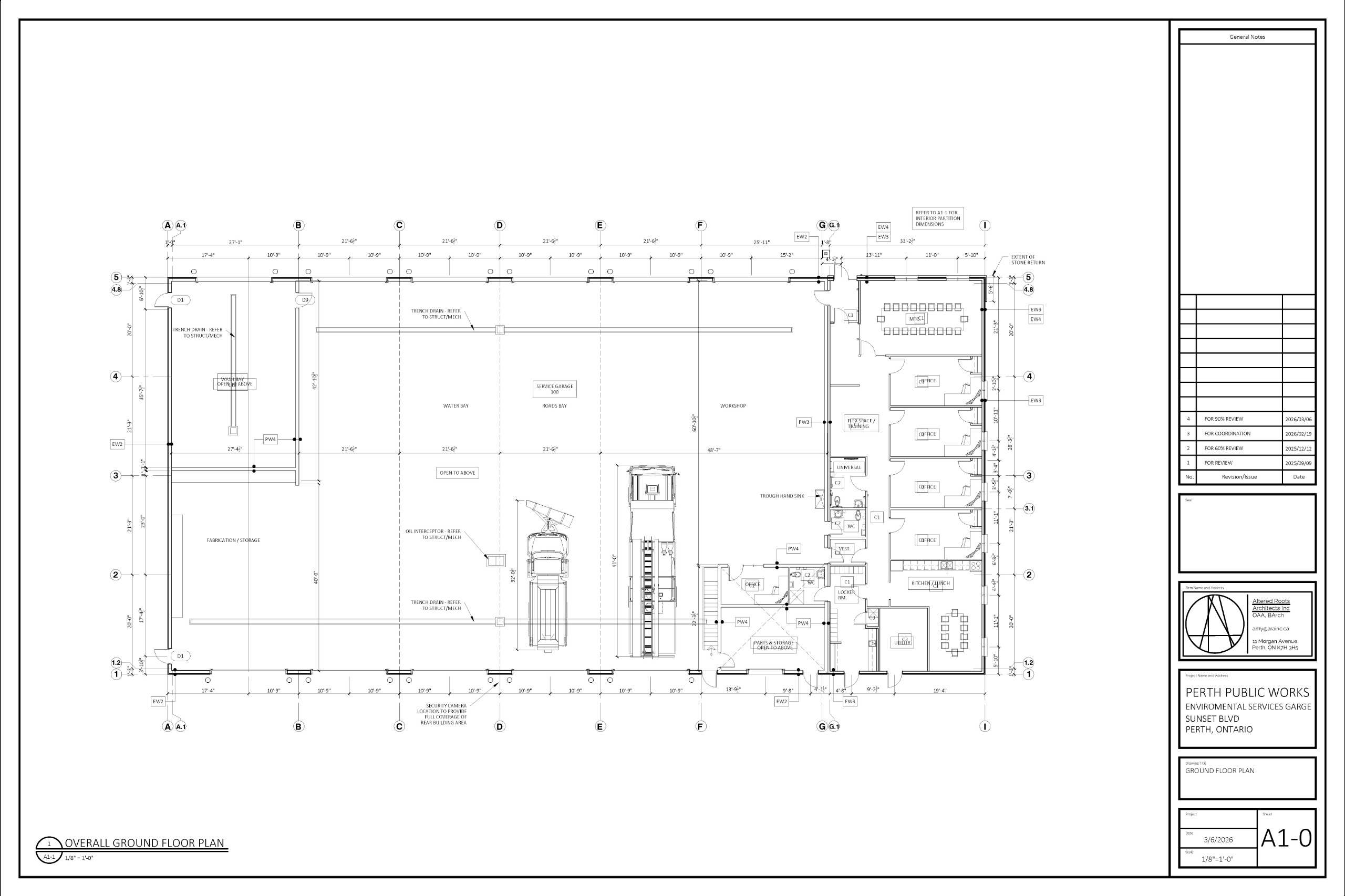
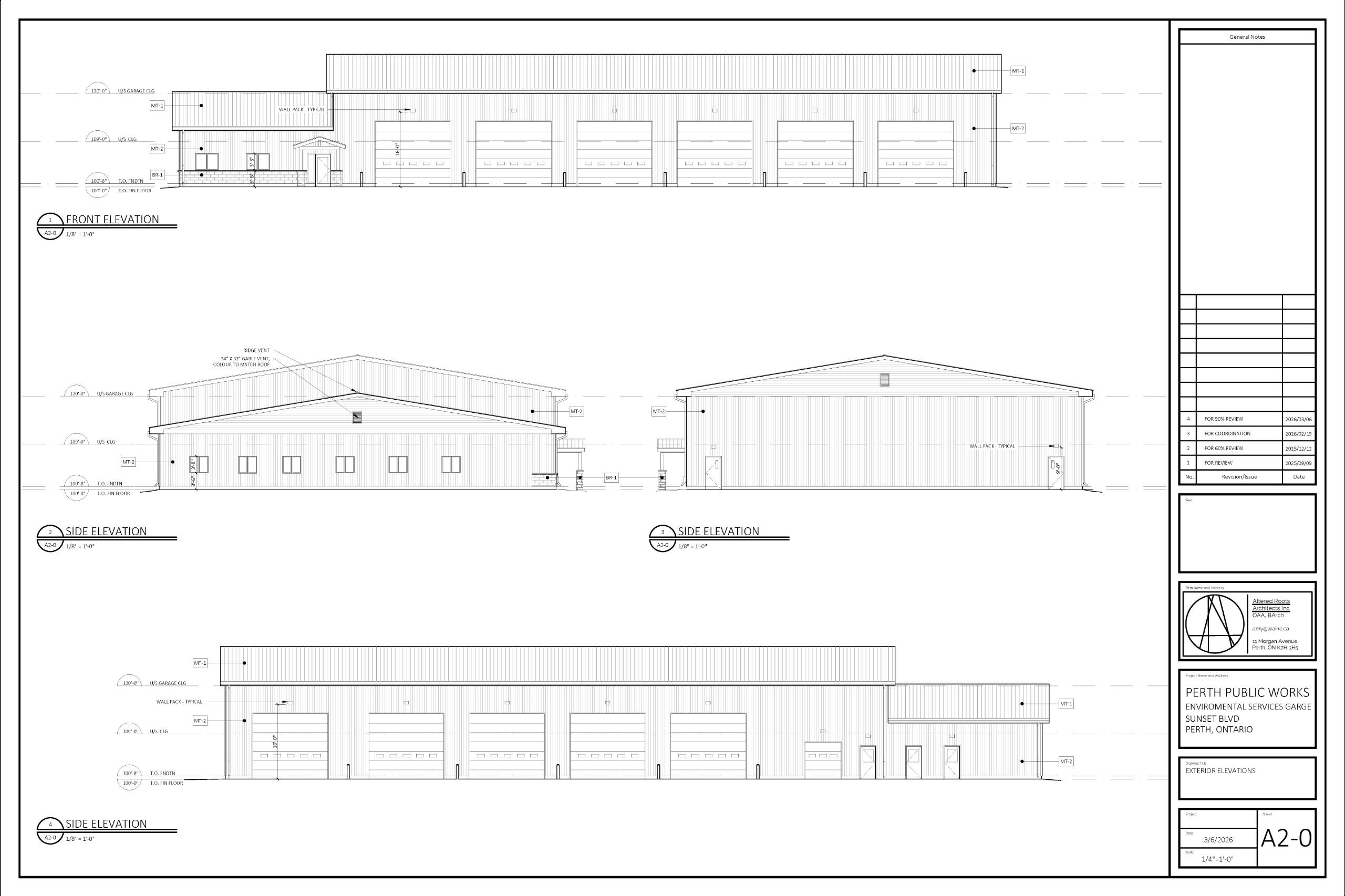
A needs assessment, concept drawings, and a Class C cost estimate were completed and presented to Council to define the scope and requirements of a new facility.
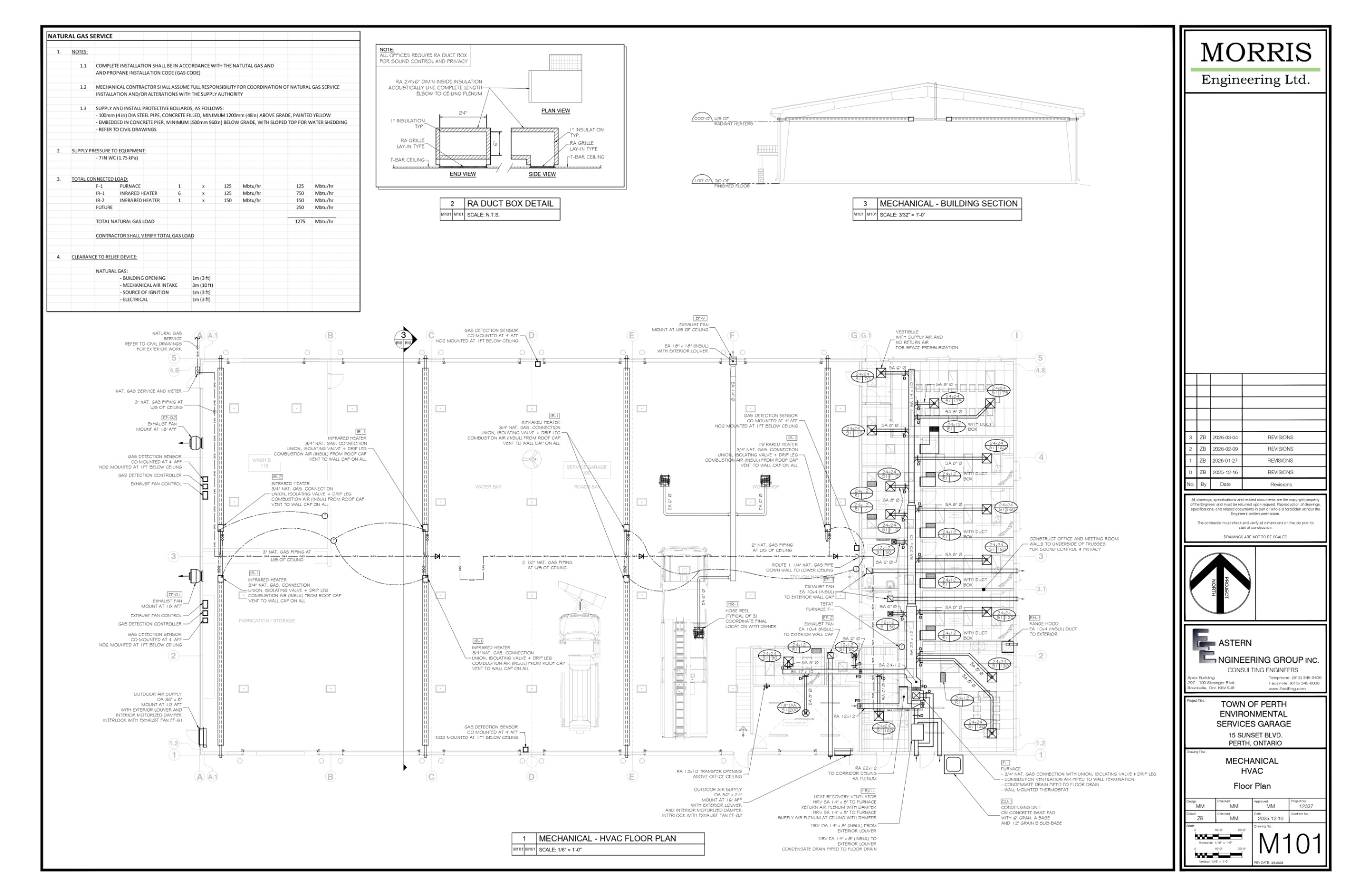
Council approved staff to move forward with the tendering process. Architectural and engineering design work is underway, with drawings currently at approximately 90% completion.
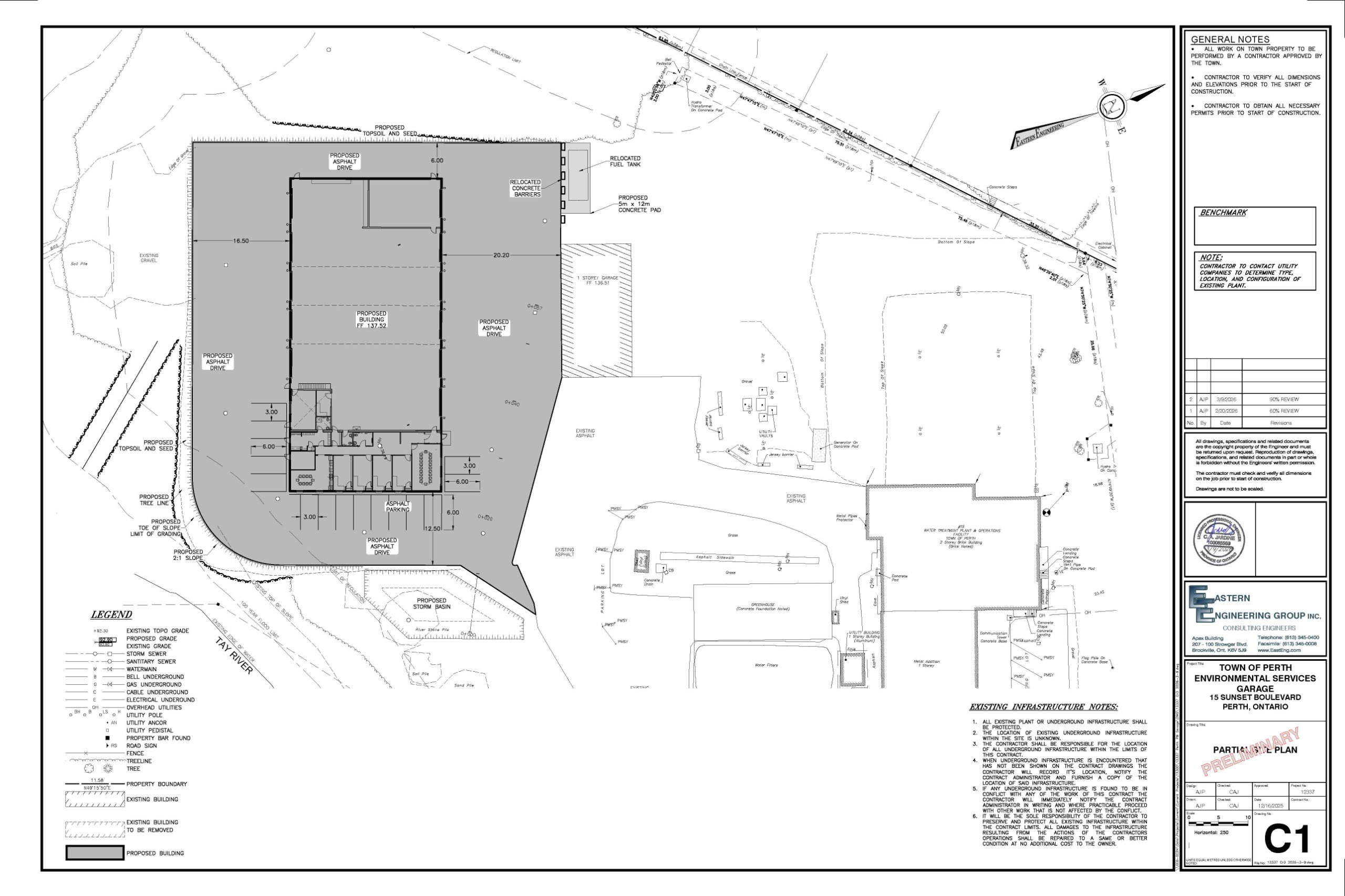
The proposed facility is planned for the Town’s existing Environmental Services property.
Building on the current site allows the Town to make use of existing land, infrastructure, and servicing already in place.
Alternative locations were explored as part of the feasibility study completed by engineers in 2024. A site north of Highway 7 was considered; however, extending services to that location was estimated to cost between $3.5 million and $5 million, in addition to the cost of constructing a new facility.
By remaining on the current property, the Town can:
This approach focuses on making the best use of existing resources while planning for future needs.
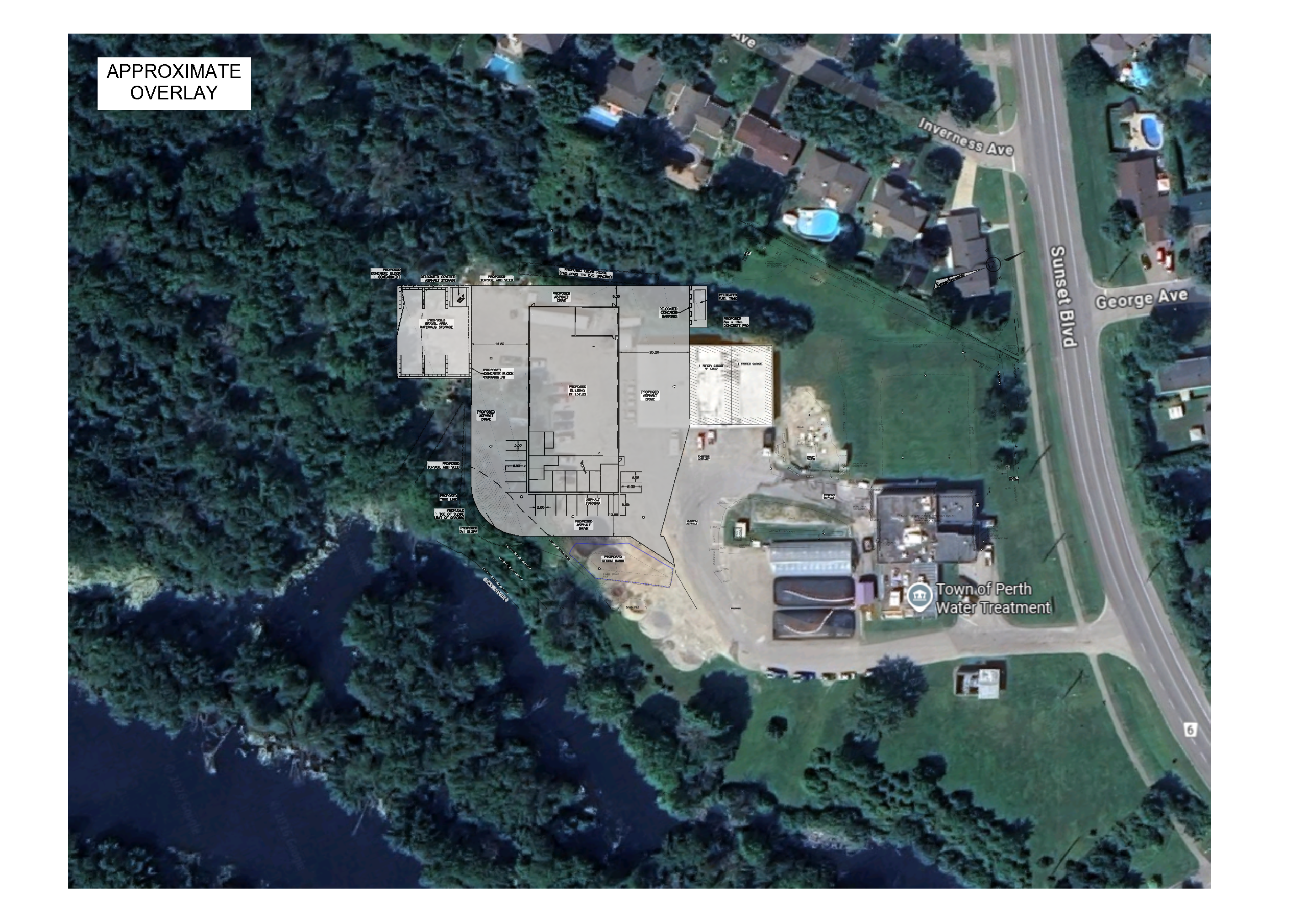
Approximate overlay of proposed facility over existing site
This project has been developed over several years through studies, planning, and Council direction, with information shared through Council reports, meetings, and public agendas.
The Town recognizes that interest in the project has increased as it has progressed. Current engagement opportunities, including an Open House and this project page, are intended to provide clear information and an opportunity for residents to learn more and ask questions.
Yes. The Town continues to engage with relevant agencies and partners as part of the project.
This includes organizations such as the Rideau Valley Conservation Authority and the Upper Canada District School Board, along with other key partners as appropriate.
Agency review is a standard part of the design and approvals process, and input is incorporated as the project progresses.
The project has progressed through feasibility, needs assessment, and design development over the past several years.
Advancing to tender allows the Town to:
Council will review the results of the tender process before making any final decision on construction.
Yes. Alternative locations were reviewed as part of the feasibility study.
These reviews considered factors such as servicing availability, land acquisition, operational efficiency, environmental constraints, and overall lifecycle cost.
Several Town-owned properties were explored, including sites on County Road 10 (North Street North), within the industrial park, and on County Road 43 (across from the Algonquin College Perth Campus), as well as the Darou Farm property.
Each of these sites presented limitations. Some would require significant investment to extend municipal services, while others are constrained by environmental considerations, floodplain location, or previous site use.
For example, servicing a site north of Highway 7 was estimated at approximately $3.5–$5 million, in addition to the cost of constructing a new facility.
Based on these considerations, the current site was identified as the most appropriate.
The current site has historically been used for municipal operations since the 1960s and continues to support essential infrastructure, including the adjacent water treatment facility.
The proposed project represents a modernization of this existing use. Even if the garage were relocated, the water treatment plant would remain, and provincial regulations limit public access in areas associated with drinking water operations.
The Town continues to invest in and expand public access to the Tay River through parks, trails, and active transportation initiatives across the community.
No. The drawings currently available reflect the design at approximately 90% completion.
They are shared to provide transparency and illustrate the proposed layout and scale of the facility. Final details may be refined as the design is completed and prepared for tender.
The facility has been designed to support current operations as well as projected growth in population, service levels, and municipal infrastructure needs over the long term.

Have questions or want to learn more about a project?
| Phone | (613) 267-3311 |
|---|---|
| Website | www.perth.ca |
| In writing | 80 Gore Street East, Perth, Ontario, K7H 1H9 |